Why a Reveal Works Only When the Clues Were There
Learn how to judge a film reveal by tracing its clues, testing the new explanation, and spotting the difference between surprise and a fair turn.
The most common mistake when judging a film reveal is to ask only whether it surprised you. That misses the real test: after the secret comes out, do earlier scenes still make sense, or does the movie need to bend them into a new story? A good reveal rewards a second look without making the first one feel like a trick played on the viewer.
To see why a reveal works, trace what the film showed, separate observation from interpretation, and check how the new information changes the story. You do not need to solve the mystery in advance. You need to notice whether the answer grows from details the film actually gave you.
What should you write down before the reveal?
Start with a viewing note that records what you can see or hear, not what you think it means. If a character pauses at a doorway, write “pauses at the doorway,” rather than “is afraid to enter.” The first note is evidence; the second is already an interpretation.
Keep the notes brief and tied to particular moments. Useful entries might include a repeated phrase, a missing object, a reaction that seems too strong, or a cut away just before someone answers. Record details that catch your attention without assuming they are clues. A film can create suspense with mood or rhythm even when a detail does not point to a secret.
Do not try to catalog every prop and line. That turns viewing into a scavenger hunt and encourages you to treat ordinary details as coded messages. Note what feels unusually emphasized, repeated, withheld, or out of step with the scene around it.
How do you tell a clue from a suspicious detail?
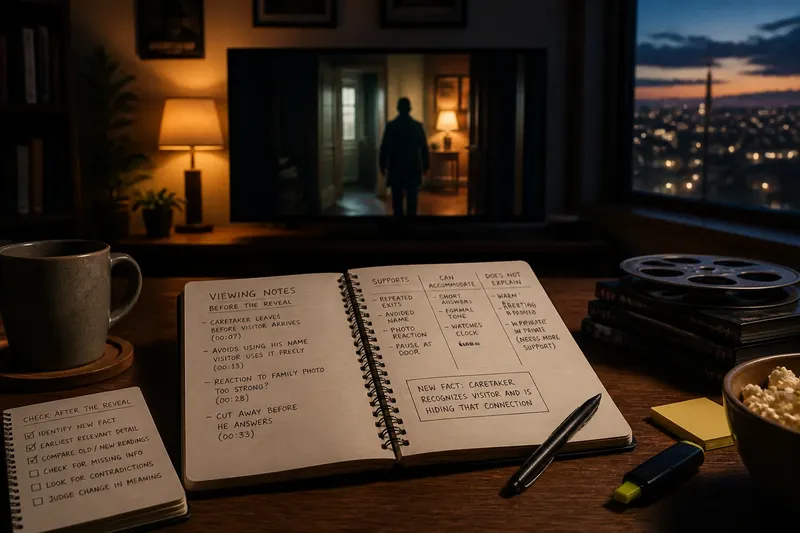
After the reveal, return to your notes and sort them into three groups: details that support the new explanation, details that the explanation can accommodate, and details it cannot explain. This is more useful than counting clues. One precise detail can matter more than several vague moments that merely feel ominous.
A clue usually has a clear place in the scene before its meaning changes. A character might avoid using a particular name, while other people use it freely. On a second look, the avoidance can fit the revealed relationship; before the reveal, it may have looked like tact, resentment, or ordinary awkwardness. The detail remains the same, while the viewer’s account of it shifts.
By contrast, a detail is suspicious but weak if it can mean anything and has no connection to later events. A shadow across a face may suggest danger, but unless the story gives that image a more specific role, it is atmosphere rather than evidence. A fair reveal does not require every visual flourish to be a clue.
Does the new explanation fit the earlier scenes?
Test the reveal against scenes that seemed clear the first time, not just the moments the film highlights afterward. Ask what each character knew, what they wanted, and why they chose the words or actions you saw. The answer should revise your reading without replacing the film’s basic continuity.
Pay special attention to dialogue. A line that once sounded like a confession may turn out to refer to something else, but its original meaning should still be plausible in the scene. If the reveal depends on a character having meant the exact opposite of what they said, look for a reason the scene supports that reading, such as a deliberate lie, a limited point of view, or a listener’s misunderstanding.
Then check the character’s behavior. A hidden motive can explain an odd choice, but it should not erase the character’s established personality or make every earlier decision inexplicable. The strongest reinterpretation often makes a small set of consequential moments clearer rather than claiming that the entire film was secretly about something else.
How can you check whether the film played fair?
Use this short review in order, after the reveal has happened:
- Identify the exact new fact. State what you learned without adding guesses about what it might mean.
- Find the earliest relevant detail. Return to the first scene that could support the reveal and note what is actually present.
- Compare the old and new readings. Ask how each interpretation fits the words, actions, and viewpoint in that scene.
- Check for missing information. Decide whether the film withheld a fact fairly or concealed something the audience was entitled to know.
- Look for contradictions. Find an earlier moment that the new explanation cannot account for, rather than treating every ambiguity as evidence in its favor.
- Judge the change in meaning. Ask whether the reveal deepens the conflict or character, not merely whether it supplies a surprising answer.
Say you watch an invented mystery in which a caretaker repeatedly leaves a room before a visitor arrives. At first, you read the exits as impatience. The reveal establishes that the caretaker recognizes the visitor but is hiding that connection; on a second look, the repeated exits, a carefully avoided name, and a strained reaction to a family photograph fit together. If the film also showed the caretaker greeting the visitor warmly in private, without explaining the apparent contradiction, the new account would need more support.
Why do some reveals feel like a cheat?
A reveal feels unfair when the film supplies a crucial fact only at the last moment and expects the audience to treat the answer as inevitable. That is different from withholding a character’s private thoughts. A story can keep a secret without showing the secret directly, but it should leave some observable trace in behavior, dialogue, or the limits of what other characters know.
Another warning sign is a point-of-view switch that changes the rules. If scenes were presented as an objective record, the film cannot easily claim that the camera concealed a basic action solely because the answer required it. If the film has clearly restricted the audience to one character’s perceptions, however, gaps and mistaken impressions may be part of the design.
Not every reveal needs to be solvable before it arrives. Mystery is not a contest in which viewers must beat the storyteller. The fair-play question is whether the film gives the answer a credible foothold in what came before, not whether you guessed it on cue.
What questions help you judge a reveal?
What is the difference between a twist and a reveal?
A twist is a sharp change in what the audience believes is happening. A reveal is the disclosure of information, which may or may not overturn that belief; either can work if the story supports the change.
Does a good reveal need obvious clues?
No. The clues can be quiet, but they should become legible once you know the answer. If they were obvious from the start, the story might lose suspense; if no earlier detail fits, the answer can feel imported.
Can a reveal work if I guessed it early?
Yes. Suspense can come from watching characters approach a truth you have already suspected. The reveal still has to clarify the evidence and change what the surrounding scenes mean.
Should every detail matter after a reveal?
No. Films use texture, pacing, and atmosphere as well as plot evidence. The answer should account for its important setup, not turn every glance, sound, or background object into a coded message.
What is not worth the effort?
It is not worth pausing over every frame to search for hidden symbols or building an elaborate theory from a single expression. That approach can make an ordinary visual choice seem like a broken promise when the reveal does not address it. Focus instead on moments the film repeats, emphasizes, or connects to a character’s choices.
For a clear judgment, return to the scene that first made the answer feel possible, then compare it with the scene that confirms it. The main question—why a reveal works—comes down to whether the new fact changes your understanding while leaving the earlier evidence intact. When both readings can live in the same film, a second look adds meaning rather than merely exposing the machinery.